Unknown's avatar

About Deb Entsminger

Deb is the great, great, great, great granddaughter of a pirate who left a legacy of alcoholism, abuse and adultery. The Lord rescued her from this her first week at the University of Florida when she moved in next door to a bunch of Nav guys who were actively living out a personal relationship with Jesus Christ. Truly, she who is forgiven much, loves much! Right from the start Deb had a deep hunger to know God and let His Word dwell in her richly as well as to pass onto others what she's learning. She has been discipling women for the past 30 years. Together with her husband Jim, she serves on staff with The Navigators.

Follow Up vs. Discipleship

“I am so frustrated!!!”  My friend exclaimed, “Sometimes she does what I ask her and other times not!  I never know what to expect!”

One thing that can help eliminate this frustration is understanding the difference between follow up and discipleship.

When someone first becomes a Christian, Jesus uses the analogy of a baby to describe them.  What do babies need?  To be fed, cared for, protected, given lots and lots of love… and to have their diapers changed!

In Ephesians Paul describes young Christians like infants tossed on the waves, not very stable and steady.  But in Hebrews 4:12 the believers are admonished, “Though by this time you ought to be teachers, you need someone to teach you again the basic principles of God.  You need milk, not solid food.”  Unlike physical babes, maturing isn’t guaranteed for believers!

This is why we are encouraged to grow (Ephesians 4:15, 2 Peter 3:18)  and 1 Peter 2:2 points out how critical God’s Word is for helping us do this.  A basic fact for both physical as well as spiritual growth – you need to eat for this to happen!  But babies often won’t eat on their own.  What a difference it makes when they have someone help them eat and then learn to feed themselves.

When Billy Graham’s crusades started taking off and thousands upon thousands were coming to know Christ, he became concerned.  What was happening to all these people afterwards?  Dawson Trotman also encountered this same dilemma after picking up a hitchhiker.  When he shared the gospel, the guy prayed to receive Christ!  A year later while sharing the gospel again Daws realized this was the same hitchhiker from the year before – his life hadn’t changed one bit.  That’s what got Dawson on the track of seeing the need for follow up.  What a difference it made when someone came alongside a new believer helping him!  Hearing of this, Billy Graham came to Dawson and asked for help developing a plan for “following up” those who became Christians at his crusades.

So follow up is helping a young believer grow.  But what’s the goal?  What are you shooting for as you do this?  And how will you know when you’ve accomplished this goal?

You want to see them become a disciple of Jesus!  The Greek word for disciple, μαθητης literally means a follower and a learner.  Not just one who acquires head knowledge, but one who takes what is being learned and makes it the conduct for her life!  We want her to follow Jesus so she can learn from Him and increasingly become like Him, joining in with what He’s doing, bearing fruit for the Father’s glory!

Now in countries where there is extreme persecution of believers, when someone becomes a Christian, they have to be a disciple because to openly declare they are following the Lord, they have to be ready to die for Him.  But here in cushy, materialistic America that’s a bit more difficult.  Usually there is a process people go through before they are ready to die to themselves and commit to follow Jesus wherever He goes, doing whatever He wants them to do, whenever He wants them doing it.

Also, before someone is ready to say to the Lord, “Not my will, but yours be done” she needs to be able to trust His way really is better!  And that He is able to do a better job guiding her life than she is!  In our broken and fallen world, where people’s trust has been violated and hearts have been wounded this can be hard to do!

So here’s the kicker – you have to be a disciple before you are ready to be discipled!  A disciple is a follower and learner.  To follow someone you have to go where he goes and do what he does – and not just when he happens to be going the way you want to go!  But you won’t come to the point of surrender, where you’re ready to follow Jesus even when your heart is screaming to go the other way, until you learn to trust Him.  So follow up is not only helping someone lay a solid foundation for a lifetime of relating with Jesus, it’s helping her grow in trusting Jesus so she will become His disciple!

This takes us back to our analogy of a baby.  All babies need to eat.  But not all food is equally nutritious!  This is also true spiritually!

Think of devotionals as watered down food. They are akin to someone sharing what God’s been teaching them.  You can learn a lot from listening to others share, but don’t let this take the place of feasting on the pure milk of the Word!  Even brand new baby Christians can do this!  The key is how it’s served!

I don’t think I ever bought a single jar of baby food.  When my son was ready for solid food, I took some of what we were eating, pulverized it with a food processor and fed that to him.  The same food in small bits can be so nourishing to a child!

This is why I love having shared quiet times with new believers.  We’ll start with a sweet psalm of adoration (as opposed to the psalms of lament – which are wonderful!  but harder to digest!) and just select one verse to camp out in.  After they’ve done this for a while, and started incorporating it as a daily part of their life, then they are ready for some meat!

How do you grow in trusting someone?  By experiencing them doing what they say they’ll do.

This is where we realize how very great and precious God’s promises truly are!  God never had to promise us anything!  But he does.  And a key reason why is so we will have opportunity to experience Him being faithful to do what He said He’ll do ~ and grow in trusting Him.  One of the best things you can ever do with someone is help her learn one promise each time you meet, discuss it so she truly understands what God has and hasn’t promised and then encourage her, how will she take God up on this offer so she can experience Him?  Then the next time you meet ask how it went as she did this.

I am telling you folks, this is like miracle grow!!!

(for more specifics on how to do this, see the article in the Helps section entitled “Promise based Follow up”)

Now as she grows at times she may look like she’s following Jesus, but where the rubber meets the road is what does she do when God leads in a different direction than where she really wants to go?  This almost always involves a crisis, where she reaches a fork in the road and a key decision has to be made – will she go Jesus’ way or her own way?  It’s a crisis because it usually involves something very dear to her.

For me, it happened when the Lord asked me to give up my major in college and follow Him studying whatever He wanted me to (and He didn’t tell me at first what that would be!).  Now I’d always been one of those people with a ten year plan.  I was studying broadcast journalism and already hosted a television show for two years and had just been appointed the Assistant Programming Director for a radio station.  How I wrestled as the Lord made it so clear He wanted me to walk away from all this.  Then one day, in July of 1983, I came to the point of surrender, left that job and became “undeclared” in my major.  At that moment I became Jesus’ disciple.  I didn’t know where we were going, but I was committed to following Him each step of the way.

That was one big, “Yes!” that every day needs to be followed by smaller yeses!  And it doesn’t mean I always get it right. But it’s a direction I’m heading and by the grace of God I pray I keep heading throughout the rest of my days!

So you follow up someone until she is ready to follow Jesus wholeheartedly!  And then the adventure of discipling begins, of helping her learn what it means to follow someone she can’t see and helping her persevere even when all hell breaks loose because Satan is so not happy about this!

But oh the joy it brings Jesus!!!  :0)

The Wisdom of Questions

If someone came up to you and asked, “What do I need to do to get eternal life?”  how would you respond?

Would you dive in sharing the bridge or another illustration?   Ask them if they’d like to start reading through the book of John with you? Share your personal testimony?

At different times I’ve done each of these.  But here’s the crazy thing… that’s not what Jesus did!

He responded with a question!  (Matthew 19:16)

In fact, if you read through the gospels, nearly every time Jesus is asked a question, he responds with a question!

Not only can this help to clarify what the person is asking, it also engages them in dialogue, drawing them into the conversation.

This is not only helpful when doing evangelism, but especially when discipling someone.  There’s a fascinating  verse in 1 John 2:27, “But you have received the Holy Spirit and he lives within you, so you don’t need anyone to teach you what is true.  For the Spirit teaches you everything you need to know, and what he teaches is true – it is not a lie.  So just as he has taught you, remain in fellowship with Christ.”

Once someone has entered into a relationship with Jesus, she has His Spirit living within her.  And God’s Spirit is so faithful to do what He’s promised to do – to teach us… if we’ll listen.  Over and over I am amazed at how true this verse is.

As I grasp the reality of this I realize my main job in discipling someone is not to teach her, but to come alongside and encourage her to remain in fellowship with Christ, to help her learn how to place herself in a position where she is able to hear what God wants to teach her and to help her learn to persevere in doing this.

A great way to do this is to ask questions – and teach her to ask questions.

The first question I ever ask before meeting with someone is of God, “What do you want me doing with this woman today?  How can I come alongside her and join in with what you’re doing?”

Then I seek to start our time asking questions about how she’s doing.  I recently met with a precious young woman who wanted to learn about forgiveness.  When I asked how she was doing she started to weep and share some painful things she was wrestling with.  It quickly became apparent learning about forgiveness was not the main reason the Lord brought us together.  When I asked, “What lies do you think the enemy is trying to get you to believe right now?” what followed was one of the most amazing one on ones I’ve had.  And I mostly listened!  Then together we considered the truth God gives in His Word to combat those lies.  And yes, we ended up in the last ten minutes talking about forgiveness as it tied in with what she was struggling with but do you see?  Without asking questions I so easily could’ve missed out on what the Lord really wanted for our time!

When I’m having a shared quiet time with someone I’m helping her learn to ask, “Where do you want me to focus today in your Word, Lord?”  “What do you want to say to me through this?” and “What difference do you want this to make in my life?”

You don’t have a daily quiet time to “be a good  Christian”  or to earn God’s favor.  You have one because this is an incredible way to learn to listen to the Lord and remain in fellowship with Him, so when He wants to teach you something you’re picking up on it and developing the discipline of responding and doing what He teaches you!  I cannot stress how radically life changing this is!!!

Now while I initially may “teach” them what I do, note the focus is on them showing up to learn from the Lord.  This helps them grow in their dependence on Him and not on me!

I need to be careful because it can be a heady thing having someone ask for your advice or ask you how to do something.  My pride loves to demonstrate what I know.  It’s so easy for that to kick in without me even realizing it and suddenly a one on one becomes a monologue.

But you know, when I take time to ask questions that really helps save me (and the woman I’m meeting with!) from this!

Plus it’s amazing how many times when I respond with a question I discover what she really is asking is rather different from what I first thought!

Good question asking is a skill.  It’s so much easier to “tell.”  But I have been amazed at how much more effective it is when my questions help people discover on their own the answer the Holy Spirit is giving them.

The good news is this is something anyone can grow in!  So I’m asking God for the grace to be more like Him in this.  And as I do, what a difference it’s making in my discipling!

It is finished!

One of the things I love about meeting with people is the way the Lord speaks to me and teaches me and challenges me through our time!

Just this morning I was camping out in Genesis 2 with a friend, showing her how when I pray through the scriptures I find it really helps if that flows out of rich time interacting with the Lord in them and then like to keep Him my focus as I pray.  So we started with a shared quiet time, then together prayed our way verse by verse through Genesis 2.  We didn’t make it past the first few verses when the Lord started speaking to me.  That whole idea of being finished just jumped right off the page!

You see, I never feel finished!  At the end of every day as I take time to process my day with the Lord I’m nearly always asking forgiveness for all I didn’t get done.  Just this past week I began to wonder about that.  After reflecting on the sweet things that took place I journaled, “…but there was so much more I could’ve done.  I wonder, am I off in my expectations?  Or am I sinning?  Because of my handicap I feel so tired after meeting with people and just want to veg.  Is that a reasonable expectation?  Yet there’s still so much undone…”

Even when I “finish” something, well there’s a long “to do” list waiting so I usually dive into the next thing.

Genesis 2 begins, “Thus the heavens and the earth were finished and all the host of them.  And on the seventh day God finished his work that he had done, and he rested on the seventh day from all his work that he had done.  So God blessed the seventh day and made it holy, because on it God rested from all his work that he had done in creation.”

Now God is still at work…  in my life, in the lives of those around me, all over this world!  So it doesn’t mean he finished all He was ever going to do.  But when the heavens and earth were finished and all the host of them, he stopped.  He rested.  And it was a blessed, holy thing.  He set a day apart to do this.

I wonder what difference it might make in my life if periodically after finishing I take time to acknowledge what’s been done, to evaluate, to delight in it, rather than rushing on to the next thing?!  God took time every day at the end of each day to do this.  At the end of the fourth day, He wasn’t bemoaning, “I didn’t get the fish created today!”  But celebrating the lights He had made and how He’d separated the light from the darkness.  Then at the end of six days He took extra time, a whole day to rest and enjoy!

This is so not the pattern of this world!  Or sadly, my world!  I thought, “Today, I’m going to take some time to write down what I’ve finished this past week and celebrate that it got done!”  But you know, I found it hard to remember what I’d finished…

My friend shared how she uses a post it app to keep track of what she needs to do.  As soon as something is accomplished it’s deleted.  And we wondered, how might we be missing out by not taking time to reflect on and celebrate what we’ve accomplished?!  I think I’m going to start keeping a list of what I finish each day!

And really I should be in awe that anything gets done at all!  In Genesis 2: 7 we’re told, “then the LORD God formed the man of dust from the ground and breathed into his nostrils the breath of life and the man became a living creature.”  Did you catch that?  We came from dust!  It’s a miracle we can do anything!

Once again it seems the enemy has incited my pride and is royally robbing me because of it.  I think more highly of myself than I ought and as a result I expect more from myself, rather than realizing, even washing the dishes is a miracle!  What expectations do you have for the dust on your coffee table?!

So I wrote in my journal on top of the page where I’ll be recording my end of the day prayers tonight, “Look what dust formed by God did!  Isn’t God amazing?!”  Because really this is all about Him.  His works are wonderful!  He is the breather, the life giver, the enabler!

And He is a finisher, evaluator, delighter, blesser and rester!  How I long to keep growing and becoming more like Him!  Did He ever give me new insights today in how I can…

Got to love the way I’m being discipled as I meet with others!  :0)

“I don’t like Jesus!”

I’d only planned to read through the Bible in a year once.  But after hearing me share highlights from doing this over and over, friends begged me to do it again and host a discussion group so they could do it too.  When we were in the middle of Leviticus two sisters started coming who didn’t know Jesus.  I thought, “Oh no!  What a place to start!”  But they kept coming and it wasn’t long until one of them entered into a relationship with the Lord!  Her sister, a legal secretary, stated, “I’m going to wait until I finish reading the whole thing!”  And sure enough, soon as we finished, she surrendered her life to the Lord!  Their lives, and all of our lives, were radically changed as a result.  Truly it was an amazing year experiencing the truth of 2 Timothy 3:16 “All scripture is given by inspiration of God and is profitable…!”

But I’ll never forget, after we finally started reading the New Testament, one friend showed up exclaiming, “I don’t like Jesus!”  She’d never read much of the Bible and was appalled by some of the things Jesus said.  As we continued reading we discovered she wasn’t the first to feel this way!  In John 6:60 even Jesus’ disciples said, “This is a hard teaching!” and at that point many of them turned away and stopped following Him.

But note when Jesus asks the twelve, “Do you want to go away as well?”  Peter replies, “Lord, to whom shall we go?  You have the words of eternal life, and we have believed and have come to know that you are the holy one of God.”

You get a whole different perspective when hard things are taken in the context of relationship and knowing who God is!

Jesus came from the Father full of grace and truth (John 1:14).  If you separate one from the other, especially focusing on truth without the context of grace, can truth ever seem harsh, cold, unappealing!

In my quiet time this past week I was reading in 1 Kings 20 where a certain man of the sons of the prophets said to his fellow at the command of the LORD, “Strike me please.”  And we aren’t just talking about getting hit.  This strike left this guy noticeably wounded and what wounds come without pain?  And I realized as I read this “sometimes to do God’s work we need to be willing to be wounded.”

photo-160

Can that ever sound harsh!   Especially if you aren’t remembering the context – and I don’t just mean the rest of 1 Kings 20!  But the entire Bible and what it reveals about who the Lord is!

photo-163

A murderer and a surgeon may both stab you.  But one does it for life!  Context makes all the difference!

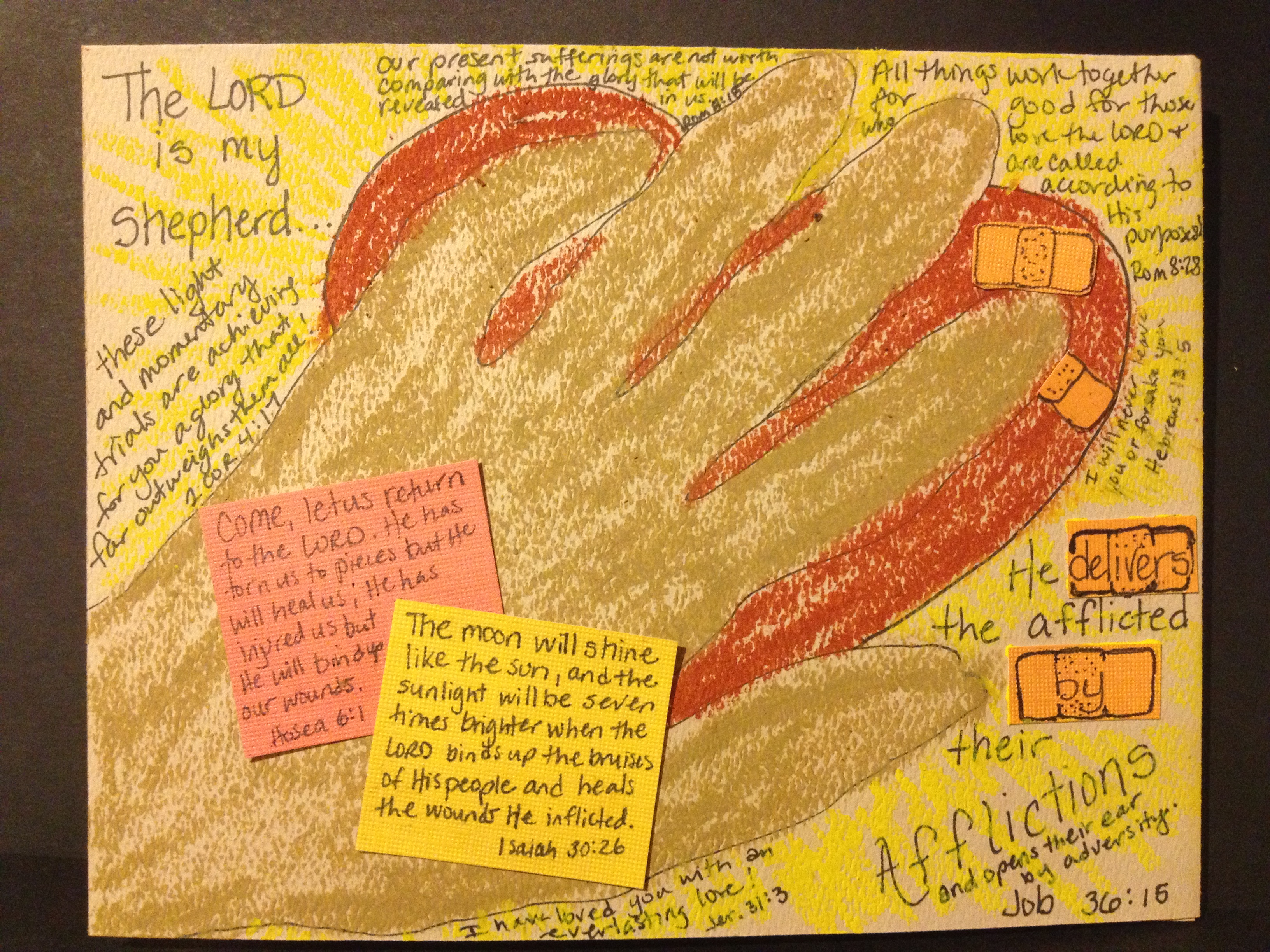
Now I’ll be honest.  There are times when the Lord allows hard things in my life I’m not happy about.  In a broken and fallen world, this happens far more than I’d like!  And yes, it often happens in the context of ministry.  Some of my deepest wounds have been inflicted by other believers I’ve been co-laboring with (sadly that’s not just true for me – the responses to my post on “friendly fire” attest to this).  It is so vital we help those we are discipling learn to run to the Lord and seek His perspective whenever they are wounded, taking time to process (for me, art journaling really helps, though I’m obviously not an artist!), letting Him provide a greater context for considering what they are going through.

However you best process, it’s so key to consider, “what has the Lord revealed in His Word that applies to what I’m going through?”

The enemy is only too happy to provide you with a context that puts the Lord in a bad light!  He desires to get us to go from “I don’t like what’s happening in my life” to “I don’t like the One who is allowing these things to happen in my life!” so we’ll avoid running to the Lord  using such reasoning as, “God can do anything and yet He’s letting you go through this?!  Obviously He doesn’t care about you!”  But that is such a lie!  Yet it’s amazing how that lie can fester and impact us and our relationship with the Lord if we don’t take the time to confront it head on and process in the presence of the Lord.

But when we do, not only do we gain a true perspective that can help us weather the worst storm but our relationship with the Lord is strengthened and we grow!!!  This really is where the rubber meets the road!

Following in a Fog

Following Jesus is hard.

And not just because He asks you to do things out of your comfort zone or because you have to give up going your way to go His.

It’s hard because you are seeking to follow someone you can’t see and frequently that can leave you wondering what in the world you’re supposed to be doing!

You see, when you call the shots it’s easy to come up with a ten year plan.  But once you say, “Not my will, but yours be done” all of a sudden you’ve handed the reigns to someone else.  You’re not in control, and He often doesn’t let you know what the next step is until right as you take it.

That can seem hard.  “I’ve given up everything to follow you!  Why don’t you make it easy?!”

Especially when there’s a decision that needs to be made.  Especially when others are chomping at the bit to know.  And let’s face it, we like to know what lies ahead!

Sometimes even as I’m doing something I’m not even certain if it’s the right thing.  But Jesus says, “Whether you turn to the right or to the left you will hear a voice behind you saying, “This is the way, walk in it.”  Did you catch that?  Sometimes it’s not until after you’re moving forward that you hear Him directing you!!!

Can that ever be scary!  Especially if we want to “get it right!”

But following Jesus is less about getting it right, than it is about being with Him.  His ways aren’t our ways!  His thoughts aren’t our thoughts.  While we’re obsessing about what we should be doing, He’s often doing something not even on our radar screen.  He often uses such times of confusion as incredible faith builders.  Will we trust Him to lead us even when it’s foggy?  Even when things are far from clear?

You see, once we realize how much better Jesus’ ways are than ours, it’s easy to slip into following Him with the motive, “I want to follow Jesus so I”ll make the right choice and life will be easier!”   I believe He sometimes allows these times of confusion to refine our motives – “Will you follow me, even when it’s hard?  Even when it means not knowing?  Even when things aren’t clear?”  Welcome to advanced faith building!

Sometimes God leads us by making the next step clear, but sometimes He leads us in the haze, guiding our steps even when we don’t realize it.  Can we follow Him during such times with a thankful heart?  Trusting Him that He really does care, that we haven’t fallen through the cracks, that even His silence can be an act of love?

Trusting Him that even if we choose wrong, He is so able to get us right where we need to be, right when we need to be there?

Or in our frenzy of trying to figure out His will (and He makes clear in Isaiah 55:8-9 the futility of trying to do this apart from Him), do we get mad at Him, frustrated because He isn’t guiding us the way we want Him to?  Or can we continue to rest in the truth of who He is, in everything giving thanks?

During times like this I so appreciate Romans 8:28, “And we know that for those who love God all things work together for good, for those who are called according to His purpose.”

What if my focus should be, “Am I loving God?” rather than “Which decision is right?”

When I am faced with an impending decision and I’m not sure what to do, well, the temptation is always there to treat God like a dog, demanding, “Speak!”  I know I need help to not fall into this trap of disrespect.  I need to pray, but that’s when I feel especially vulnerable.  It’s so easy to obsess about the situation even as I’m praying about it!

That’s when I grab this resource:  http://www.memlok.com/adoration.pdf  What a gift this has been!!!  I fold it into fourths and take it with me as I walk and pray, focusing on who God is.  In the midst of a fog, this is what I need the most – to remember what is true about God’s character.  I can’t even begin to tell you how this helps set my heart at rest… to be reminded He is here, He really does care, He is on the throne, He is wise and good, there is purpose in all He does…

God has promised to guide us.  But He doesn’t always do it the way we’d like or the easiest way.  Can we trust Him to be faithful to His promises even in a fog?

When we do, we don’t just get where we need to be, we also get a major opportunity to grow ~ and bring Him pleasure!  (Hebrews 11:6)

The Joy of Active Learning

What’s the best learning experience you ever had?  What made it so helpful?  Most likely it wasn’t a time where you simply sat and listened to someone.

I am currently taking an art journaling class and it is wonderful!  Every week I learn so much!  But there’s barely any time spent sitting still listening or scribbling notes.  The instructor gives us step by step, direct guidance helping us create a picture similar to one she already fashioned.  As she’s teaching it, we are doing it!  But she also gives us freedom to be creative as we make our own pages.  In the process, are we ever learning new art techniques!  This really is a wonderful way to learn!  And that’s not only true for art journaling classes…

People really do learn best when actively engaged!

Recognizing this, adult learning specialists identify four types of learning tasks:  Inductive task, Input task, Implementation task, and Integration task.  Now that may sound a bit heady, but I have to tell you as I attended a workshop on this today I was amazed to discover my best “one on ones” really do employ all four types of tasks.  Can this ever help to de-mystify why some “one on ones” are so impactful whereas others aren’t.

For example, when I share with someone for the first time how to have a quiet time, there are four key things I do:

1.  First, I ask her to share with me what, if anything she’s done before for a quiet time.  As she describes the different things she’s tried in the past or even what she’s doing currently I always ask, “How is that working for you?” Nearly every one admits to struggling so there is an eagerness to want to learn something that will truly help.

This is one example of an inductive task.  “An inductive task begins with the life and experience of learners and describes their present conception of the topic.  An inductive task sets the stage for learning by showing what the person already knows.  In a well designed inductive task learners are connecting their life-long experience to new content.”**

2.   Then I ask if she’d like to see what’s benefitted me for the past thirty years.  I show her my current quiet time notebook and explain what I do, then give her a notebook so she can write the outline down in a format ready for her to use.   (eg., “Look, Listen, Live It out”)

This is an example of an input task.  “Input tasks invite the learner to grapple with new knowledge, skill or attitudes.  The learner is challenged to do something with this in order to learn it.”**

3.  Next we do a shared quiet time together – this truly is my favorite part!  (For more specifics on this see the article “How to have a Shared Quiet Time” in the Helps section)

This is an example of an implementation task.  “Implementation tasks invite the learner to use the new knowledge, skill or attitude in the learning environment immediately.”**

4.  Finally, I give her a bookmark listing suggested Psalms she can go to for quiet times in the coming week and encourage her to do so on her own.  Sometimes I even encourage her to do with someone else what we’ve done together, helping a friend learn how to have a shared quiet time!

These are both examples of integration tasks. “An integration task invites learners to apply what they have learned to their life and work.  Typically the participant would select a time after the program and agree to send a report to the facilitators when this has been accomplished.”**

As much as possible seek to utilize all four types of tasks each time you meet.  One of the worst things you can do is get together and spend the whole time telling her things!  And while the names may sound daunting, it’s actually very basic – find out what she already knows, share with her something new that can help her and spur her on, do it with her, then encourage her to do it on her own.

And note – there is a best order for these tasks occurring – you don’t want to wait till the end to ask, “By the way, what have you done in the past?!”

Once again I am in awe of the Lord and the way He so faithfully guides when I take Him up on His offer in James 1:5, asking Him for wisdom while preparing to meet with women!  Does it ever bring joy discovering reasons why His ideas work!


**All quotes are copied from a handout by David Dougherty distributed at his “Using Learning Tasks”  workshop given at Navigator Headquarters, October 16, 2013.  More information on these learning tasks can be found in Jane Vella’s book Taking Learning to Task.

What’s Your Concept of God?

In Luke 19:11-27 Jesus tells a fascinating parable.  In this story, the master calls ten of his servants and gives each of them ten minas – a mina was about three months wages – and the master tells them, “Engage in business until I come!”  After the master becomes King he returns to find the first servant doubled what he gave him, ending up with 20 minas, the next servant earned five minas more, but the third servant did nothing.

Why didn’t this guy do anything with what he was given?  What reason did he give?

“I was afraid of you, because you are a severe man…”  Do you see how his concept of his master influenced what he did (and didn’t!) do?!

A.W. Tozer stated, “What comes to our mind when we think about God is the most important thing about us.”

Why?  Because it’s not just a matter of thinking!  What we think about God greatly impacts what we do and don’t do!

What is your concept of God?

That can be a fascinating question to ask others.  Once when my husband asked a group of college students, one replied, “He’s like a proctor.  Always looking to see if you’re behaving right and every once in a while coming along, giving you hints to help you not make mistakes.”

Who wants to spend time with a proctor?!  Do you see how key it is to find out what people’s concept of God is? Especially if we are inviting them into a personal relationship with Him.

But this is also true for believers – though we may have more difficulty articulating it.  Thoughts of what our concept should be can often muddy us  recognizing what it is – but much can be discerned from how we live and the choices we do or don’t make.

Whenever  I start meeting one on one with someone this is always a key thing I’m seeking to determine – not necessarily by asking outright, but through observation.  Can this ever give great insight into how to make the best use of our time.

Is she struggling with anger?  bitterness?  or anxiety?  Struggling with wanting to control her life?  Struggling feeling like she needs to be protective of her time, her energy, her resources, herself?

To just say, “stop it!”  doesn’t help!  There is far more going on than the behavior.  In fact, if you focus on the behavior you may very well miss truly being of help discipling her.  Remember the goal in discipling is to help someone learn how to do what she’s said “yes” to!  To help someone learn how to follow Jesus and keep learning from Him in a life-changing, transformational way.

Now it may not always be possible to identify exactly where her concept of God is off – in truth, I’m not sure if this side of heaven anyone ever has a totally accurate concept of God.  But just realizing there’s something amiss that’s hindering her from running in the path of His commands can really help get you going in the right direction – focusing on who the Lord truly is.

One of my favorite ways to do this (because it doesn’t just benefit those I’m meeting with but so fortifies my soul each time I do it!) is to take her to the first chapter of Genesis with colored pencils in hand.  So many times when people think about this chapter either the creation-evolution debate comes to mind or the focus is on what was created.

But if you read through Genesis 1 together highlighting with a colored pencil each time God’s name is mentioned (or a pronoun referring to Him) does it ever become evident this chapter is primarily about Him!  As one friend exclaimed, “He’s mentioned in nearly every verse!”

And I share how God is the main character  in the Bible.  Take any Bible story, for example, David and Goliath – that story isn’t primarily about David or Goliath but about the Lord.  If it wasn’t for Him there would’ve been no story!  Same thing regarding Jonah and the Big Fish!  Without God, Jonah would’ve ended up a tasty meal!

So Genesis really is the Lord introducing Himself.  If you never knew anything about Him but just had Genesis 1 and 2, it’s amazing what you can learn!  Rather than giving a list of attributes, in these opening chapters God lets us see Him in action!  First in all His power and majesty and wisdom creating everything, then through a smaller snapshot revealing how personal and relational He truly is.

So next we read back through Genesis 1 with a different colored pencil in hand, underlining all the verbs that tells us what God does.  Afterwards we take a sheet of paper and make three columns on it.  As we start sharing what we learn about God from Genesis 1, we write each observation down in the first column.  Then we consider what are the implications for our life that He is this way?

Oh how I love doing this with people!!!  It is so beautiful to camp out considering who the Lord has revealed Himself to be and why He’s chosen to reveal this!

Once we’re done I encourage my friend to take time on her own to go back through the list and consider how she has personally experienced the Lord being each of these things and to write out the stories, her stories that come to mind!  What a powerful way to spend extended time alone with the Lord!

Then we close our time praying back and forth through our list of observations,  praising God for who we’ve seen Him to be in Genesis 1 and in that context sharing whatever is on our hearts with Him.

It’s like the old story about counterfeit money – the best way to learn how to identify it is to become familiar with the real thing!  The best way to identify counterfeit ways we think about God isn’t to focus on where we’re off, but to focus, meditate and reflect on who He has revealed Himself to be – both in His Word as well as personally to us through our experiences of Him.

Grace and Truth!

Jesus came from the Father full of grace and truth!  (John 1:14)  Grace and truth are intricately intertwined like strands of DNA.  If you separate one from the other you can really get off base!

For example, the first time I ever did an evangelistic Bible discussion I invited three friends over and we read through the first chapter of Romans.  I thought, “Hey, I’ve heard of people using ‘Romans Road’ to share the gospel – why not start with this book!”  My friends gathered in my dorm room, I gave a Bible to each, and we started reading.  As soon as we reached Romans 1:24…

Therefore God gave them over in the sinful desires of their hearts to sexual impurity for the degrading of their bodies with one another. “

My one friend who occasionally went to church and was living with her boyfriend slammed her Bible shut, saying, “I don’t believe this!  You don’t have to believe this to be a Christian!”  Then my other friend said, “I think I like her version of Christianity better than yours!”  And all three of them stood up and walked out!

I was in shock!  I hadn’t even said a word!

Since then I’ve learned this is why it’s so much better to start with the gospel of John – it gives people the opportunity to see grace as well as truth lived out by Jesus.  That is such a powerful combination!

And not just for unbelievers!

This is one of the problems we face when we take isolated verses to focus on.  Even in the “What is a Disciple” study, found in the “Helps” section, if you just read Luke 14:26-33 where Jesus shares requirements for being His disciple they can sound pretty severe, especially if someone has been deeply wounded in her past and struggles to trust.

When Jesus says, “In the same way, those of you who do not give up everything you have cannot be my disciples” it’s so vital we read that against the backdrop of Psalm 23:1 “The Lord is my shepherd.  I lack nothing” and Psalm 35:27 “The Lord be exalted, who delights in the well-being of his servant” or from the New Testament, John 1:16 “From the fulness of his grace we have all received one blessing after another” and Philippians 4:19 “my God will supply all your needs according to His riches in glory.”

In Luke 14, Jesus isn’t coldly demanding harsh sacrifices that leave us in the dust!  He’s saying stop trying to take care of yourself, stop relying on yourself.  He’s asking us to do this in the context of trusting Him that He loves us, that He can take better care of us than we can ourselves and will steadfastly, always, not just when we deserve it!

This is why it is so vital young believers get to know who Jesus is!  And that all throughout our lives we keep reminding ourselves who He is!

I love to take people through the study “24 hours with John” or Helene Ashker’s “Jesus Cares for Women.”  It is so critical to learn these truths (and remember them!) about who He is, in the context of seeing Him live out grace as He relates to those around Him. God could’ve just given us a list of truths but instead He blesses us with four accounts where we can see Jesus in action full of grace and truth.

If you’re struggling or those you are meeting with are struggling to give up controlling their lives, by all means go to the Gospels to see Jesus in action.  When you take time to do this, can it ever help build trust in Him!


NOTE;  You can find a pdf of the study “24 Hours With John”  here:  http://www.navigators.org/us/ministries/college/navfusion/assets/24%20Hours%20with%20John.pdf

I always like to go through the questions on my own first before meeting with someone.  Depending on where they are coming from  – if I feel a need to keep it more informal, I’ll write the questions in the margin of my Bible.  But if they are more serious in their seeking I will type out the questions to give to them so they can reflect on them after we’ve parted (do not include the answers when you do this!!!  Provided answers kill discussion!).  As time goes on, I will often offer to give them the questions for next week in advance so they can have more time to think about their answers.  One other benefit of giving them the questions – it’s much easier for them to pass this on to others – either to share with friends during the week or later on to know what to do when they meet someone else seeking!  I have done this study countless times and every single time I do I learn more about Jesus!  And does that ever help me keep giving the reign in my life over to Jesus!  This is an ongoing process!  And ongoing input sure can be a HUGE help!

NOTE:  You can purchase a copy of Helene Ashker’s book Jesus Cares for Women here:  

http://www.amazon.com/Jesus-Cares-For-Women-Evangelistic/dp/0891091904/ref=sr_1_1?ie=UTF8&qid=1381029796&sr=8-1&keywords=Jesus+cares+for+women

You only need one copy of this book for yourself as the study is reproducible – or you can also write the questions in the margin of your Bible.  This is a much shorter study – it only takes 5 weeks to complete – but is it ever a potent one!


Discipling Like Jesus… part 2

So… this is the first time I’ve tried doing a blog in two parts – but I’m thinking there might be some of you who’d enjoy getting to experience first hand a taste of what I do when I’m meeting with someone one on one helping her learn how to disciple others.  I only wish I could be sitting on the couch with you doing this in person!  :0)

To get the full benefit of this, if you haven’t yet read and done part one, go check it out and after reading through Luke 11:1-13 create a chart and answer the three questions:

  1. What can you learn about discipling from this interaction between Jesus and His disciples?
  2. For each observation, consider:  Why do you think Jesus did this?
  3. How could you apply this when you are discipling the women you meet with?

There really is a ton to be learned from this passage!   Here are a few things that stood out to me!

1.  THE VALUE OF MODELING

Note this entire discourse begins with Jesus praying.  I cannot stress how vital modeling is in discipleship – it’s not just what you say!  What you do has a much greater impact!  Now Jesus wasn’t doing this just to model for the disciples, but as he prayed, did it ever capture their attention!  As we look at the Scriptures we see it was a way of life for him. Don’t just meet one on one with someone, give them opportunity to see you live out your relationship with the Lord in your daily life.

2.  CAPITALIZE ON CURIOSITY

And note this discussion was prompted by the disciples.  They observed Jesus doing this as well as John teaching his disciples and they were curious.  People learn things much better when it’s something they are interested in and want to learn.  That’s not to say there aren’t times when it’s important to cover things they may not have thought about before.  But when possible, taking time to discover what someone is curious about and focusing there can really increase the impact of the lesson.

3.  KEEP IT SIMPLE & ORGANIZED

Note how Jesus begins giving them something simple and organized, a model they can easily remember. This is so impactful.  This doesn’t include everything Jesus ever taught on prayer.  He didn’t feel like he had to cram all that could be learned into one lesson!  But is it ever a great way to start!

This is why I love to use the Look, Listen, Live it out model for teaching someone how to have a quiet time.  Not only is it easy for them to remember the next day, but it’s also easy for them to remember so they can pass it on to someone else!

There’s a fascinating book called Making Things Stick that explores how to present information in ways people will remember.  This book stresses, keeping things simple and organized can really help!  As my friend Dave Hawes says, “The more organized something is, the more passonable it is.”  and not just from you to her, but also for her to pass onto others!!!

For example I was doing a sexual purity video and had nine practical suggestions for how people who are struggling can experience victory in this area of life.  Who can remember nine suggestions?!  So I asked the Lord if He’d give me an idea for how to communicate this in a way that would stick and He brought to mind the three parts of the briar:  roots, stem, and flower.  So using a large picture of a briar, I shared three suggestions for each of the three parts!  Did that ever stick!  (no pun intended! :0)

4.  UTILIZE REPETITION & REVIEW

Note Luke 11 wasn’t the only time the Lord taught the disciples about prayer.  In Matthew 6:5-14 we see the Lord teaching the disciples to pray using this model again.  Repetition is so valuable!  Don’t just teach something once and then move on, assuming she got it.  Periodically coming back to go over something, teaching it in a bit of a different way can be so helpful!

Note in Luke 11 Jesus only teaches part of this model for prayer – in Matthew 6 we see an expanded version.  But in Luke 11 Jesus spends more time talking about the parts He does present.

5.  PROMOTE UNDERSTANDING

So first he teaches them part of a simple model, then he takes time to help them understand.  He starts with the whole, then breaks it down focusing on one key part at a time.

And He seeks to help the disciples understand the character of who they are praying too as He does this.  Just as in the Bible the main character is always God, so in your one on ones let Him be the focus.

And it’s important the one you’re meeting with understands what’s not being said, as well as what’s said.  You want to try and anticipate ways the enemy might try to twist what you’re teaching and get her off track.  For example, after Jesus instructs the disciples, “ask and it will be given to you,” He goes on to explain God only gives good gifts.  So when you ask you will receive something, and it will be good!  But you may not get exactly what you’re asking for!

Do you see how the enemy can have a heyday with this if someone is expecting to always get exactly what she asks for?

6.  HIGHLIGHT A KEY APPLICATION IDEA

And then Jesus ends highlighting the best thing they can ever ask for and be given!  Be sure to end your explanation highlighting what is most important and giving her ideas for how she can practically apply what you’ve just taught her in her daily life.

Note Jesus doesn’t exhaust them with a long dissertation on this subject.  He briefly teaches them a simple model.  Then explains what they need to know to get started and be motivated to start.

Now we don’t know what happened next.  Scripture just gives us brief snapshots, so I’m going to take the liberty to add on two more things that I’ve observed from other passages of Scripture that help me finish well when I’m meeting with someone.

7.   DO IT WITH THEM!   (Luke 9:13-17)

I have found it so helpful to not just tell people how to do something, but when I take time during our time together to do it with them – that’s when it really sticks!  This provides a great launch for getting them started!

For example, when sharing the Lord’s prayer with someone, I don’t just tell them about it, I pray through it with them!  And not rotely – remember it’s a model, not just a verbatim prayer to pray!   And as we pray through it, we take turns, with me going first, praying one phrase at a time, expanding it a bit to share what’s on our hearts that relates to each phrase.

8.  GIVE AN ASSIGNMENT  (Mark 6:7)

And then I end with an assignment such as, try praying through this model once a day for the next week (which is something I seek to do at the start of every day in my own life, right after I wake up each morning before I get out of bed and truly have found to be life changing!).

This is where the rubber meets the road – why you’re sharing this with them in the first place… so they’ll do it!

Incorporating anything new into one’s life rarely just happens!  That’s why discipleship is so helpful in the first place!  Be sure you consider not just what you’re going to tell them, but how to intentionally spur them on towards love and good deeds!

And as you do, can following Jesus’ example ever help!

Discipling Like Jesus… part 1

One of the best ways to learn what to do with someone when you are discipling them is to look at Jesus’ life and note what he taught his disciples.  There is so much to learn from His example – not only about content but also how to pass treasure on.

For example, consider Luke 11:1-13…

Now Jesus was praying in a certain place, and when he finished, one of his disciples said to him, “Lord, teach us to pray, as John taught his disciples.”  2 And he said to them, “When you pray, say:

             “Father, hallowed be your name.

             Your kingdom come.

3              Give us each day our daily bread,

4              and forgive us our sins,

                        for we ourselves forgive everyone who is indebted to us.

             And lead us not into temptation.”

 5   And he said to them, “Which of you who has a friend will go to him at midnight and say to him, ‘Friend, lend me three loaves, 6 for a friend of mine has arrived on a journey, and I have nothing to set before him’; 7 and he will answer from within, ‘Do not bother me; the door is now shut, and my children are with me in bed. I cannot get up and give you anything’? 8 I tell you, though he will not get up and give him anything because he is his friend, yet because of his impudence he will rise and give him whatever he needs. 9 And I tell you, ask, and it will be given to you; seek, and you will find; knock, and it will be opened to you. 10 For everyone who asks receives, and the one who seeks finds, and to the one who knocks it will be opened. 11 What father among you, if his son asks for a fish, will instead of a fish give him a serpent; 12 or if he asks for an egg, will give him a scorpion? 13 If you then, who are evil, know how to give good gifts to your children, how much more will the heavenly Father give the Holy Spirit to those who ask him!”

In a recent one on one I read this passage with a friend, then asked her to take a few moments and answer the following questions (it’s helpful if you create a chart with three columns, with one question from below heading each column):

  1. What can you learn about discipling from this interaction between Jesus and His disciples?
  2. For each observation, consider:  Why do you think Jesus did this?
  3. How could you apply this when you are discipling the women you meet with?

It’s pretty fascinating if you take the time to do this!  Why not take a few moments right now and dive in?!  ;0)